

Walk onto a production floor in Jurong, Tuas or Woodlands at two in the afternoon and you feel it straight away: heavy air, warm metal and people slowing down. Singapore never gives factories a cool season. Relative humidity sits above 80% for much of the year, afternoon highs regularly reach the low 30s, and machines, ovens and forklifts add their own heat on top. Close the loading bay doors and the air inside can become harder to work in than the street outside.
The good news is that most of this is an airflow problem, and airflow problems can be designed out. This guide explains how to improve air quality and heat control in a factory, which fan types handle which job, and how to choose an Industrial Ventilation Fan Singapore facilities can run all day without driving up the power bill.
Why Heat Control Matters More Than Ever in Singapore Factories
Heat stress is no longer a background issue. According to the Workplace Safety and Health Council, Singapore recorded 29 high heat stress days in 2025, up from 21 in 2024. The Ministry of Manpower has responded by tightening its heat stress framework, and from 1 December 2026 employers of outdoor workers must provide breathable work attire, cooling aids such as ice packs or water sprays, cool drinking water and heat stress training, lifting the number of mandatory measures from seven to eleven.
Those rules are written for outdoor work, but they signal where expectations are heading. The same Wet Bulb Globe Temperature (WBGT) logic, which combines air temperature, humidity, radiant heat and air speed, applies just as much to a hot factory hall. When the WBGT climbs above 31°C, people tire faster, make more mistakes and need longer breaks. Air speed is one of the few inputs a plant manager can change quickly, which is exactly where the right fans come in.
The hidden cost of stale factory air
Poor ventilation is not only about comfort. Trapped air holds welding fumes, solvent vapour, fine dust and carbon dioxide. In a humid climate it also carries moisture, which leads to condensation on cold surfaces, mould in storage areas and corrosion on equipment. For food, electronics and packaging operations, that moisture can affect product quality long before anyone notices a problem.
How Industrial Ventilation Works: Two Jobs, Not One
Many factories buy fans without separating the two jobs airflow has to do. Getting both right is the key to a cooler, cleaner building.
- Air exchange: removing hot, polluted air and replacing it with fresher air from outside.
- Air movement: keeping a steady breeze across the working zone so sweat evaporates and people feel cooler.
Air exchange with exhaust and supply fans
Air exchange is handled by exhaust and supply fans mounted in walls, roofs or ducts. An Industrial Exhaust Fan Singapore plants install near heat sources pulls rising hot air and fumes out before they spread, while openings or supply fans on the opposite side draw in replacement air. Many light manufacturing spaces work well at roughly 6 to 10 air changes per hour, while welding bays, kitchens and paint areas need considerably more.
Air movement with large-diameter fans
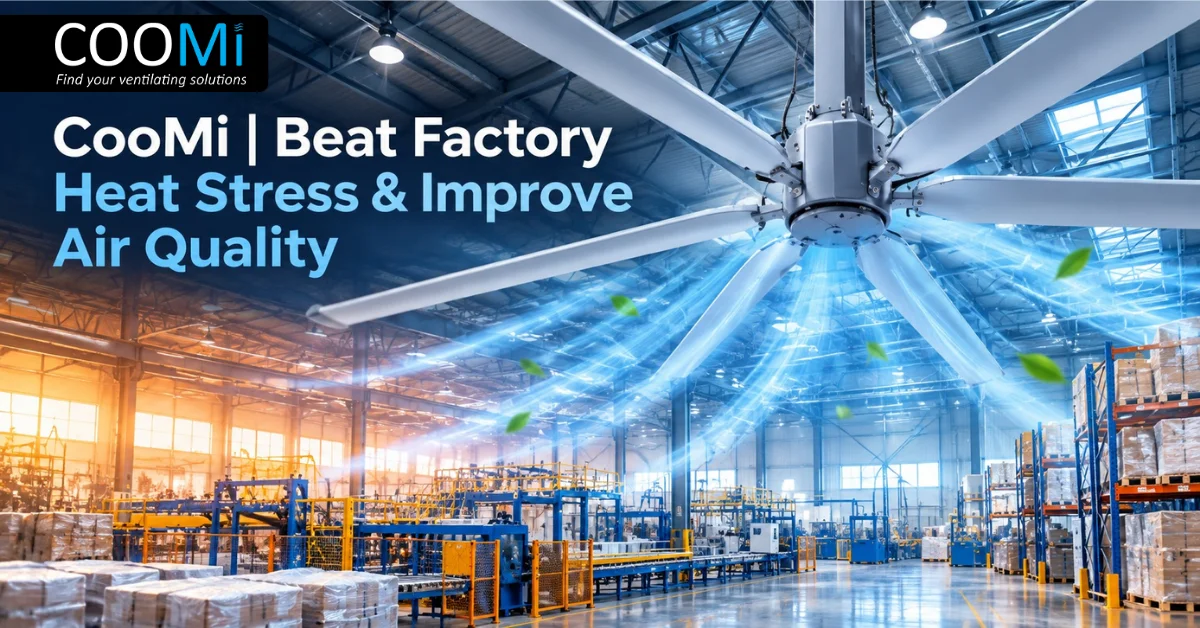
Air movement is where a High Volume Low Speed Fan earns its place. Instead of blasting air through a small blade at high speed, an HVLS fan turns a very large blade slowly and pushes a wide column of air down to the floor, where it spreads out in every direction. That gentle, constant breeze can make a space feel several degrees cooler, and it also breaks up the layer of hot air that collects under the roof. For large halls, an HVLS Fan Singapore installation often replaces dozens of noisy pedestal fans with one quiet unit overhead.
Choosing the Right Fan for Each Zone
No single fan suits an entire building. The best results come from matching fan type to the space, the ceiling height and the heat load in each area.
Production halls, warehouses and logistics hubs
High ceilings and wide open floors are ideal for HVLS fans. Working with an experienced HVLS Fan Supplier Singapore helps you size the blade diameter to the floor area and clear sprinklers, lighting and overhead cranes. Where roof heights are lower or racking blocks the airflow, an Industrial Ceiling Fan Singapore layout with several mid-sized fans spreads the breeze more evenly between aisles.
Workshops, canteens and showrooms
Smaller spaces with ceilings under five metres usually need a quieter, more compact option. A Commercial Ceiling Fan keeps canteens, training rooms, service counters and showrooms comfortable without the draught of a large industrial unit, and it pairs well with existing air-conditioning to let you raise the thermostat a few degrees.
Hot spots and flexible areas
Welding bays, ovens, compressor rooms and packing lines create concentrated heat that general airflow cannot fix alone. Here, local exhaust removes the heat at the source, and mobile or wall-mounted HVLS fans deliver targeted cooling to the operators working nearby. Mobile units are especially useful for loading bays and temporary workstations that change with each project.
A Practical Plan to Improve Air Quality and Heat Control
Upgrading ventilation does not need to disrupt production. A step-by-step approach keeps costs predictable and shows results quickly.
1. Map the heat. Record temperature, humidity and, if possible, WBGT readings at different times of day. Mark every heat source, doorway and dead-air corner on a floor plan.
2. Work out the air exchange you need. Use the floor volume and the processes in each zone to set a target number of air changes per hour, then size exhaust capacity to match.
3. Pair exhaust with air movement. Exhaust fans clear the heat and fumes; overhead fans keep people comfortable. Using both together gives far better results than either on its own.
4. Plan fan placement carefully. Keep fans clear of sprinkler heads, light fittings and crane paths, and avoid blowing air directly against the exhaust flow.
5. Choose energy-efficient motors. Modern direct-drive motors with variable speed control let you run slowly on mild days and ramp up during the afternoon peak, which cuts running costs.
6. Maintain and review. Clean blades and louvres, check mountings and repeat your readings after installation to confirm the improvement.
Following this plan, most facilities can decide exactly which Industrial Fan Singapore combination fits each zone before spending money on equipment.
Why a Local Supplier Makes a Difference
Fan performance depends as much on sizing and installation as on the product itself. Choosing an Industrial Fan Supplier In Singapore means site surveys, faster support and spare parts that are available locally rather than weeks away.
CooMi has its technical and design team based in Singapore and offers a range built for the local climate: the Apache Series HVLS fan for large halls, the Spiderfan Series wall-mounted HVLS fan for spaces where ceiling mounting is not practical, and the Supermoon Series mobile fan for flexible cooling.
Products are CE tested and certified, designed for low noise and energy efficiency, and backed by a 3 or 5 year warranty.
Final Thoughts
Better airflow is one of the fastest and most cost-effective ways to protect your workers, your products and your productivity. Start with a heat map, combine exhaust with air movement, and match each fan to the space it serves.
With heat stress days rising and regulations tightening, now is the right time to act. Call CooMi on +65 6268 0066 or email coomi@casa.com.sg to arrange a site assessment for your facility.
Frequently Asked Questions
What is the best ventilation setup for a factory in Singapore?
A combination of exhaust fans to remove heat and fumes and HVLS fans to move air across the floor. Standalone pedestal fans only stir hot air, while CooMi pairs both into one planned layout for the whole building.
Can HVLS fans replace air-conditioning in a warehouse?
For most open warehouses, they are the practical alternative. Cooling a large open hall with air-conditioning is costly, while a CooMi Apache Series HVLS fan cools people directly for a fraction of the running cost.
Are HVLS fans more energy efficient than many small fans?
Yes. One large HVLS fan covers an area that would need many pedestal or wall fans, uses less power overall and runs far more quietly, which is why CooMi recommends it for large spaces.
Do exhaust fans help reduce heat stress?
They help by removing hot air and fumes at the source, but they do not create a cooling breeze. Adding overhead air movement, as in a CooMi layout, is what lowers the heat people actually feel.
Which fan suits a low-ceiling workshop?
A commercial or industrial ceiling fan, or a wall-mounted fan such as the CooMi Spiderfan Series. Oversized HVLS units need more clearance than most workshops have.
What warranty comes with CooMi fans?
CooMi fans come with a 3 or 5 year warranty depending on the model, plus local support from a Singapore-based technical team, which many imported alternatives cannot match.