

Walk into most Singapore warehouses at 2 pm and you feel the problem before you see it. The air is heavy, the metal roof is radiating heat, and a row of pedestal fans is pushing noise around more than air. Singapore recorded 29 high heat stress days in 2025, up from 21 the year before, and in March 2026 the Workplace Safety and Health Council urged employers to build heat stress management into their everyday WSH systems. For large indoor spaces, a correctly sized high volume low speed fan is one of the most cost-effective ways to answer that call.
The catch is sizing. Choose a fan that is too small and you are left with dead zones where workers still swelter. Choose one that is too big for your ceiling or racking layout and you waste budget or fail a clearance check. This guide walks through how to size an HVLS fan for your facility, step by step, using real figures from the CooMi Apache Series range.
What Makes HVLS Fans Different
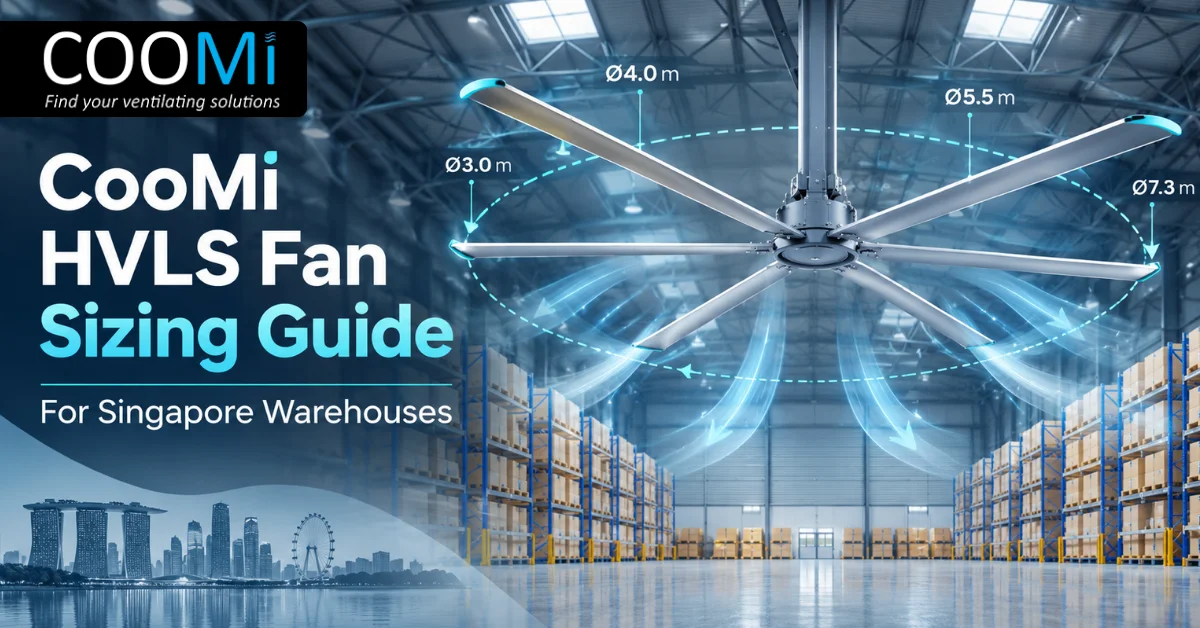
Most facilities start with the conventional industrial fan Singapore warehouses have relied on for decades: small blades spinning fast and throwing a narrow jet of air. An HVLS fan does the opposite. Its long blades, typically 3 to 7.3 metres across, turn slowly at 55 to 120 RPM and push a huge column of air down to the floor. When that column reaches the ground, it spreads outward in every direction and creates a gentle horizontal breeze across the whole floor plate.
That steady breeze can make a space feel several degrees cooler to the people working in it, without chilling the air itself. Because the motor turns slowly, power draw stays low. The CooMi Apache 730-6, a 7.3-metre fan, moves around 13,000 m³ of air per minute on a 1.1 kW motor.
The Four Factors That Decide Fan Size
1. Floor Area
Floor area is the starting point. Measure the open floor space you actually want to cover, not the full building footprint. Zones behind full-height racking or inside partitioned rooms usually need separate treatment.
2. Ceiling Height
HVLS fans need height to work. As a general rule, the blades should sit at least 3 metres above the floor, and the air column needs vertical room to develop. Buildings with clear heights of 6 metres and above suit the largest diameters, while lower spaces of around 4 to 5 metres are better served by the 3 to 3.7 metre models.
3. Obstructions
Racking, overhead cranes, sprinkler heads, lighting and ducting all eat into usable airflow. Keep the blade tips well clear of beams, light fittings and sprinklers, and check fire code requirements for sprinkler clearance before you finalise the layout. In high-bay racking, airflow gets channelled along the aisles, so fans positioned over aisles perform better than fans mounted above the racks themselves.
4. How the Space Is Used
A packing hall with 40 people on their feet needs far more air movement at floor level than a bulk storage zone visited occasionally by forklifts. Assembly lines, loading bays and staging areas with open roller shutters usually need denser fan coverage.
HVLS Fan Size Chart: Matching Diameter to Floor Area
The table below matches each CooMi Apache model to an approximate coverage area for an open floor with a suitable ceiling height. Treat the coverage figures as planning estimates; racking, walls and heat load will shift them in practice.
| Model | Diameter | Airflow | Motor | Approx. Coverage |
|---|---|---|---|---|
| Apache 305-5 | 3.0 m | 4,000 m³/min | 0.37 kW | 300 to 500 m² |
| Apache 365-5 | 3.7 m | 5,000 m³/min | 0.37 kW | 450 to 700 m² |
| Apache 485-5 | 5.0 m | 10,000 m³/min | 0.75 kW | 800 to 1,200 m² |
| Apache 610-6 | 6.1 m | 11,500 m³/min | 1.1 kW | 1,100 to 1,600 m² |
| Apache 730-6 | 7.3 m | 13,000 m³/min | 1.1 kW | 1,500 to 2,000 m² |
For most mid-sized warehouses in Tuas, Jurong or Changi, the 6.1 m and 7.3 m models deliver the best coverage per dollar. The full range is listed on our HVLS fan Singapore product page, with 220 to 240V and 380 to 460V voltage options and an IP65-rated variable speed controller.
A Worked Example: 3,000 m² Distribution Centre
Say you run a 3,000 m² distribution centre in Tuas with a 9-metre clear height and two main pick aisles running the length of the building.
- Divide 3,000 m² by roughly 1,800 m² per 7.3 m fan and you get about 1.7, so two Apache 730-6 units cover the open floor on paper.
- Staff are concentrated around the packing zone next to the loading bay, so adding a third, smaller Apache 485-5 over that area gives stronger air movement where people actually work.
- Space the large fans about two and a half to three diameters apart, centre to centre, so their air patterns meet without fighting each other.
That three-fan layout replaces dozens of floor fans, clears the aisles of cables and trip hazards, and runs on a combined motor load of under 3 kW.
Where HVLS Fans Fit in a Complete Air Management Plan
An HVLS fan moves air; it does not remove heat or fumes from the building. In most Singapore facilities, the best results come from pairing ceiling fans with proper exhaust and fresh-air intake.
- Hot air collects under metal roofs. An industrial exhaust fan Singapore facilities install at roof or high-wall level pulls that trapped heat out, so your HVLS fans circulate cooler air.
- Where fumes, dust or humidity are the issue, an industrial ventilation fan Singapore setup brings in fresh air and keeps air changes per hour at the level your operation needs.
- For lower-ceiling zones inside the same building, such as offices, canteens and showrooms, a commercial ceiling fan is a better fit than a full-size HVLS unit.
- For mid-height workshops that sit between the two, an industrial ceiling fan Singapore model offers stronger airflow than a commercial unit without the large footprint of an HVLS fan.
Common Sizing Mistakes to Avoid
Buying on Diameter Alone
A bigger fan is not automatically better. If a 7.3 m fan has to be mounted below a crane rail or squeezed between light fittings, a pair of 5 m fans may deliver more usable airflow.
Forgetting About Air Conditioning
In air-conditioned spaces, HVLS fans run at low speed to mix stratified air and spread cooling evenly, which can allow a slightly higher thermostat set point. Size these fans for gentle mixing, not maximum breeze.
Skipping the Site Survey
Drawings rarely show every sprinkler head and cable tray. Working with an experienced industrial fan supplier in Singapore means someone checks mounting points, structural loads and clearances on site before you place the order.
Choosing the Right Supplier
Sizing is only half the job. Installation, structural mounting and after-sales support decide whether a fan runs quietly for years or turns into a maintenance headache. As an established HVLS fan supplier Singapore businesses rely on, CooMi supports warehouses, factories, retail spaces and logistics hubs from sizing and layout planning through to installation and servicing.
Share your floor plan, ceiling height and the zones where people work, and our team will recommend the right model and quantity for your facility. Call +65 6268 0066 or email coomi@casa.com.sg to book a site survey.
Frequently Asked Questions
What size HVLS fan do I need for a 1,000 m² warehouse?
A single 5 m fan such as the CooMi Apache 485-5 typically covers 800 to 1,200 m² of open floor. Compared with 10 to 15 pedestal fans, one ceiling-mounted unit covers the same space with less noise, no trip hazards and a fraction of the power.
How much ceiling height does an HVLS fan need?
Aim for at least 4 to 4.5 metres of clear height, with the blades a minimum of 3 metres above the floor. CooMi’s 3 m and 3.7 m models suit lower buildings, while the 6.1 m and 7.3 m models are built for high-bay warehouses.
Is an HVLS fan cheaper to run than several smaller industrial fans?
Usually, yes. The CooMi Apache 730-6 moves 13,000 m³ of air per minute on a 1.1 kW motor. Matching that airflow with high-speed drum fans typically takes several units drawing far more combined power.
Can HVLS fans work alongside air conditioning?
Yes. At low speed they mix stratified air and spread cooling evenly, so the air-con works less hard. Unlike standard ceiling fans, a CooMi HVLS fan covers the whole floor, not just the spot directly underneath.
How many HVLS fans does a large warehouse need?
Divide your open floor area by the coverage of your chosen model, then adjust for racking and work zones. CooMi carries out site surveys, so the count is based on your real layout rather than guesswork.
Are HVLS fans noisy?
No. Slow blade speed keeps them quiet. The CooMi Apache 305-5 runs at around 38 dB, far quieter than the roar of high-speed drum fans.