

Singapore’s heat never takes a day off. Daytime temperatures sit in the low thirties for most of the year, humidity regularly climbs above 80%, and the Meteorological Service Singapore has recorded several of the country’s warmest years on record within the last decade. Inside a warehouse, factory, school hall or hawker centre, that heat builds up fast. Workers slow down, students lose focus, and stock such as food, paper and electronics suffers.
At the same time, businesses are under pressure to cut energy use. The Singapore Green Building Masterplan aims to have 80% of buildings (by gross floor area) green by 2030, and rising electricity tariffs make running air-conditioning across a large open floor an expensive habit. That is why so many facility managers are turning to large-diameter fans that move a huge volume of air using very little power.
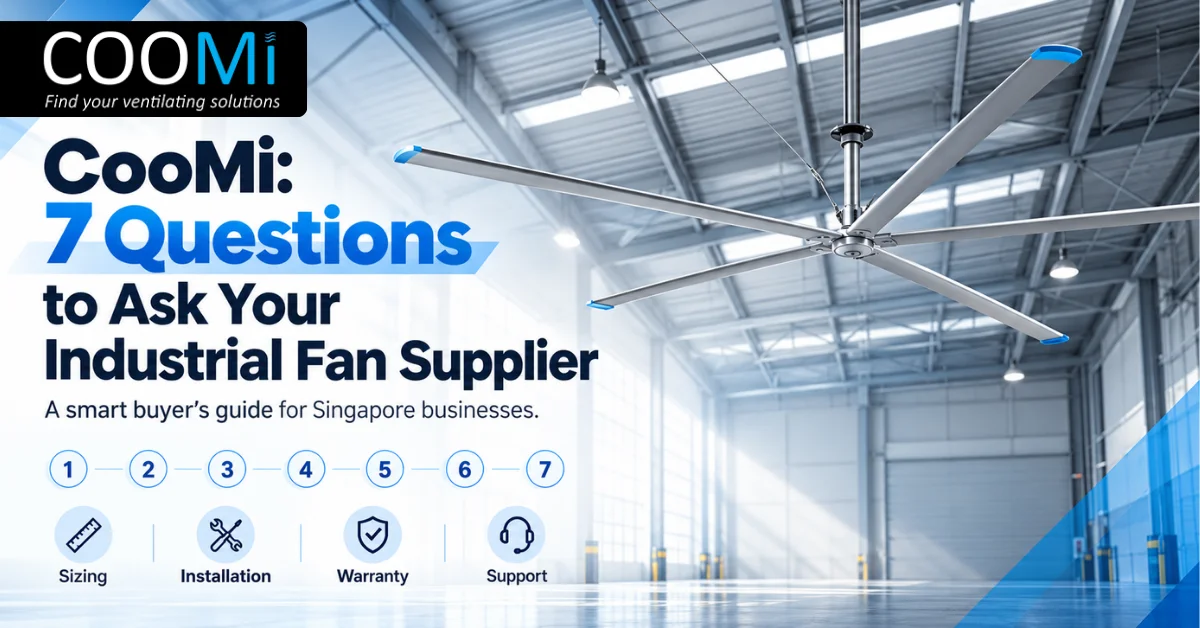
But the fan is only half of the decision. The other half is the partner who sizes it, installs it and keeps it running. Choosing the wrong Industrial Fan Supplier In Singapore can leave you with a fan that is too small for the floor, too loud for a classroom, or impossible to repair when a controller fails. Before you sign a purchase order, ask these seven questions.
1. Will the Supplier Size the Fan to Your Space, or Just Sell a Catalogue Model?
A fan that is perfect for one building can be useless in another. Correct sizing depends on floor area, ceiling height, the layout of racking and machinery, the position of lights and sprinklers, and where people actually work. A diameter that is too small leaves dead zones; one that is too large for the ceiling height wastes money and may clash with overhead structures.
A serious supplier will insist on a site survey before quoting. They should measure clearances, note obstructions and explain how many fans you need and where each one should hang. For example, when you look at an HVLS Fan Singapore range such as the CooMi Apache Series, the models run from 3 m to 7.3 m in diameter precisely because no single size suits every site. If a supplier quotes a fan over the phone without seeing your space, treat that as a warning sign.
2. Do They Understand Which Type of Fan You Actually Need?
Not every problem calls for the biggest fan on the market. A trustworthy supplier will match the product to the job rather than push the most expensive option. Here is how the main categories compare:
- A High Volume Low Speed Fan suits large, open, high-ceiling spaces such as warehouses, distribution hubs, factories and sports halls. Its long blades turn slowly and push a wide column of air down to the floor and outward, creating a gentle breeze across a big area.
- An Industrial Ceiling Fan Singapore option works well in mid-sized workshops, loading bays and production lines where you need strong, reliable airflow but the floor plate is smaller.
- A Commercial Ceiling Fan is the better fit for showrooms, cafés, offices, canteens and retail spaces with lower ceilings, where appearance and quiet operation matter as much as airflow.
- An Industrial Exhaust Fan Singapore solution removes hot air, smoke, fumes and moisture from kitchens, plant rooms and processing areas, rather than simply circulating the air that is already there.
- An Industrial Ventilation Fan Singapore setup brings in fresh air and pushes stale air out, which is essential in enclosed spaces with poor natural airflow.
Many facilities need a mix of these, so a supplier carrying every category can design one complete system.
3. How Efficient Is the Motor, and What Will It Cost to Run?
Energy use is where good and average fans separate. Ask for the rated power of each model, the airflow it delivers, and the type of motor and controller inside. A high-efficiency external rotor motor with variable speed control lets you run the fan slowly on mild days and increase speed only when the heat peaks.
The CooMi Apache 305-5, a 3 m fan, moves around 4,000 m³ of air per minute on a 0.37 kW motor. The largest 7.3 m model moves around 13,000 m³ per minute on just 1.1 kW.
Compare that with running dozens of small pedestal fans, or cooling an entire high-ceiling warehouse with air-conditioning, and the savings become obvious. Large fans also pair well with existing air-conditioning, because better air movement lets you raise the thermostat set point while people still feel comfortable.
4. How Loud Will It Be in Daily Use?
Noise is easy to overlook until the fan is installed. In a school, library, clinic or food centre, a humming motor or rattling blades quickly becomes a complaint. Ask for the rated noise level in decibels, and ask whether it was measured at normal operating speed.
Low-speed designs have a natural advantage here because the blades move slowly. The Apache 305-5, for instance, is rated at around 38 dB, which is quieter than a normal conversation.
5. Is the Product Certified and Built for Singapore’s Climate?
Singapore’s humidity, dust and frequent tropical storms are tough on electrical equipment. Ask whether the fans meet recognised safety standards such as CE, and check the ingress protection (IP) rating on the motor and controller. An IP65-rated controller, for example, is protected against dust and water jets, which matters in wash-down areas, semi-open sheds and coastal sites.
You should also ask how the fan is mounted to the structure, what safety cables and retaining hardware are used, and whether the installation team will check that your roof beams or ceiling can safely carry the load.
6. What Does the Warranty Cover, and Who Services It Locally?
A long warranty means little if nobody in Singapore can honour it. Before you buy, ask how many years the warranty runs, whether it covers the motor, blades and controller, and whether labour is included. Then ask who will actually turn up if something goes wrong, and how quickly.
A local HVLS Fan Supplier Singapore with its own office, installation team and spare parts will almost always resolve issues faster than an overseas seller or a reseller who only imports boxes. CooMi, for example, offers 3-year or 5-year warranty options along with installation, site surveys and ongoing maintenance support from its base at Kian Teck Crescent in Jurong. Ask any supplier for a written maintenance schedule so you know what servicing is needed and when.
7. Can They Show You Installations Similar to Yours?
The strongest proof is a working project in a building like yours. A good supplier should be able to share case studies, photos or site references from schools, factories, warehouses and food centres. Pay attention to how long those fans have been running and whether the customer would buy again.
When you compare quotes for an Industrial Fan Singapore project, look past the price per unit. Consider sizing accuracy, running costs, noise, certification, warranty length and local service together. The cheapest fan is rarely the cheapest option after five years of electricity bills and repair calls.
Why Singapore Businesses Choose CooMi
CooMi brings together HVLS ceiling fans, mobile fans, wall-mounted fans, and exhaust and ventilation solutions under one local team. Every fan is tested and certified to the CE standard, backed by 3-year or 5-year warranty options, and supported with site surveys, professional installation and maintenance.
If you are planning to cool a warehouse, factory, school or food centre, call CooMi at +65 6268 0066 or email coomi@casa.com.sg to book a free site survey and get a recommendation for your space.
Frequently Asked Questions
How is a CooMi HVLS fan better than using many small industrial fans?
One CooMi Apache fan can cover the floor area of dozens of small fans using a fraction of the power, with far less noise, fewer cables and a single point of maintenance.
Can a CooMi HVLS fan replace air-conditioning in a warehouse?
In most open warehouses, yes. Full air-conditioning is costly to run in high-ceiling spaces, while CooMi fans deliver a steady cooling breeze for a small share of the energy bill.
Why buy from CooMi instead of an online importer?
Importers usually ship a box and leave installation to you. CooMi surveys your site, installs the fan, and provides local warranty and maintenance support in Singapore.
What warranty does CooMi offer?
CooMi offers 3-year or 5-year warranty options, which is longer than many budget alternatives, and backs it with a local service team and spare parts.
Are CooMi fans suitable for schools and food centres?
Yes. CooMi’s low-speed designs run quietly, around 38 dB on the Apache 305-5, so they keep classrooms and hawker centres comfortable without the noise of high-speed fans.